
Programmes
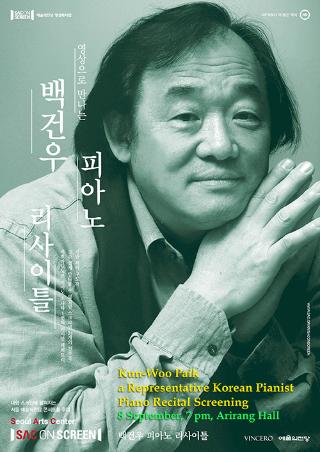
Kun-Woo Paik, a Representative Korean Pianist
- Director Kun-Woo Paik
- Cast -
- Running Time 91Minutes
- Screening Date
Kun Woo Paik was born in Seoul. He gave his first concert, aged
10, with the Korean National Orchestra, playing Grieg's Piano
Concerto. In the following years he
performed many important works in Korea, including several local premieres such
as Mussorgsky's Pictures at an Exhibition. Later he
studied in New York (Juilliard School), London,
and in Italy with Rosina Lhévinne, Ilona Kabos, Guido Agosti and Wilhelm Kempff. Kun Woo
Paik is also a laureate of the Naumburg and Busoni International Piano Competitions.
[Kun-Woo Paik, Piano Recital Screening]
The world famous Korean pianist Kun-Woo
Paik will provide a special stage to celebrate the 100th anniversary
of the death of the Russian composer Alexander Scriabin. It will showcase
refreshing interpretations of Russian repertoires at the hands of Kun-Woo Paik,
who has captivated audiences with unique inspirations.
[Program Note]
A. Scriabin / 24 Preludes, Op.11
Scriabin was born in Moscow and studied
at Moscow Conservatory. He was not only a composer who made substantial
contributions to the creation of new harmony, but also a pianist. Throughout
his life, he was devoted to composing preludes. His musical inspiration was
crystalized in small compositions called “Preludes for Piano.” Twenty-four
preludes were selected from those he composed between 1888 and 1896. With
similar arrangements as Chopin’s “24 Preludes,” they were released in 1897 as
“24 Preludes, Op.11.” While they show traces of Chopin’s influences, they also
provide Scriabin’s creative individuality.
S. Rachmaninoff / Piano Sonata No.1 in d
minor, Op.28
Rachmaninoff composed “Piano Sonata No.1
in d minor, Op.28” while staying in Dresden, Germany. Inspired by Goethe’s
Faust, he tried to express the story in a piano sonata. After numerous trials,
he finally completed a piano sonata in 1908 and performed it for the first time
on October 17, 1908. It is modestly Classical with heavy touches of late Romanticism.

 Facebook
 X
X
 YouTube
 Instagram
